Nova: A Federated Orchestrator
Kubernetes makes it easy to run workloads in a single cluster, but operating across multiple clusters, regions, and cloud providers introduces complexity in placement, cost optimization, and resource availability.
Nova is a policy-driven multi-cluster control plane that allows you to treat a fleet of Kubernetes clusters as a single logical compute fabric, automatically placing workloads on workload clusters based on user-defined policies.
Core Concepts
- Control Plane: Central API that evaluates policies and coordinates placement decisions
- Workload Clusters: Kubernetes clusters where workloads are ultimately deployed
- SchedulePolicy: Defines how and where workloads should be placed across clusters
- ScheduleGroup: Groups related resources to ensure they are co-located
How Nova Works
- Connect workload clusters to the Nova control plane
- Define a SchedulePolicy describing where workloads should run
- Apply standard Kubernetes manifests to the Nova control plane
- Nova selects the most appropriate cluster and deploys the workload
These steps use standard Kubernetes APIs, allowing existing manifests to be applied without modification.
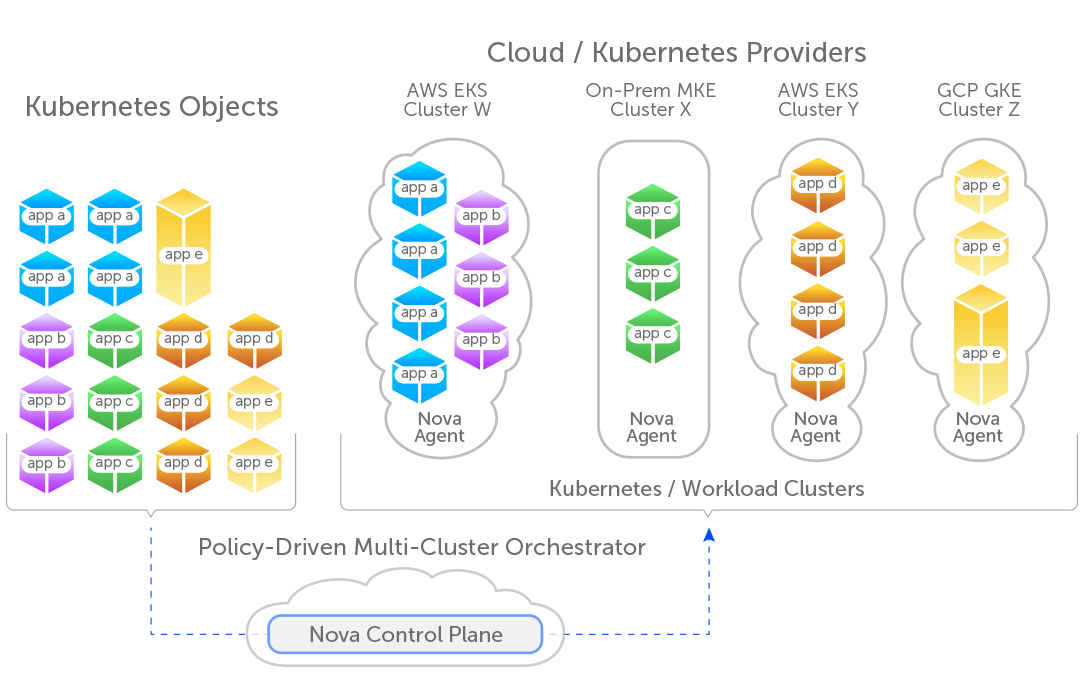
In this example:
- A workload is submitted
- Nova evaluates available clusters
- The workload is placed on the most appropriate cluster
- Related components can be grouped and co-located
This allows users to treat multiple clusters as a single logical compute pool.
Nova supports placing workloads composed of commonly used Kubernetes resource types, including core primitives such as Deployments, StatefulSets, Services, Jobs, and their associated resources.
A full list of supported resource types is available in the Supported API Resources.
Workloads that rely on unsupported or highly specialized resource types may not be fully managed or placed by Nova.
Core Components
Nova consists of a central control plane and agents that run in each workload cluster.
The diagram below shows the primary Nova components and how they communicate.
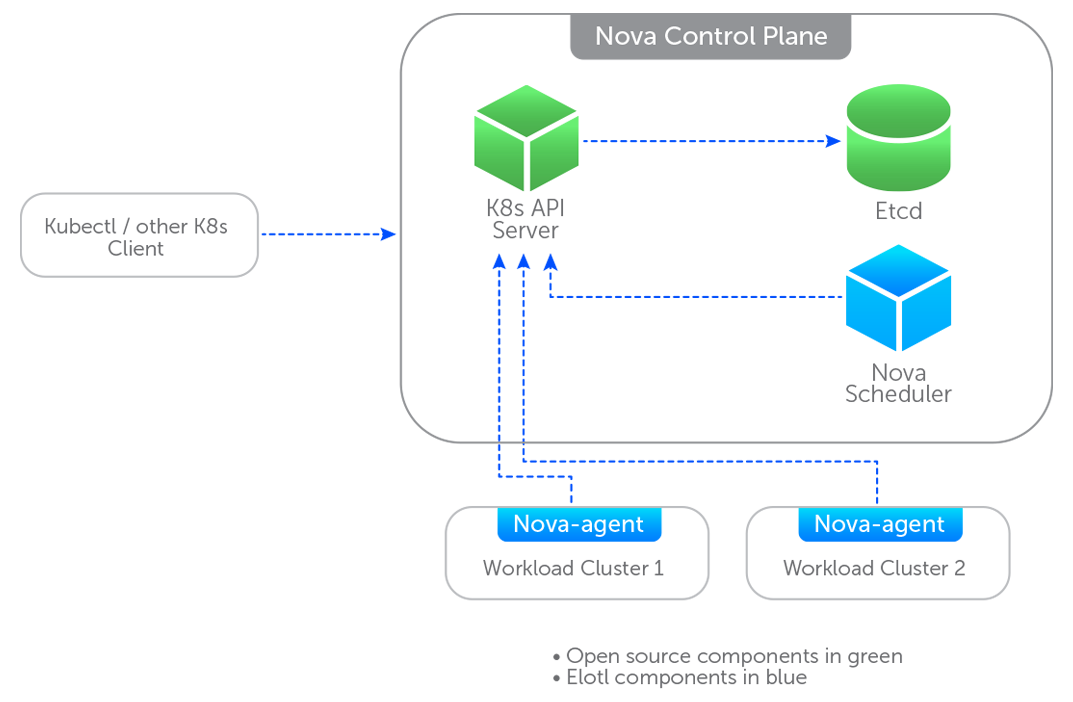
At a high level:
- The Nova Control Plane stores configuration, evaluates policies, and coordinates placement decisions
- The Nova Agent runs in each workload cluster and communicates with the control plane
- Workload clusters are the Kubernetes clusters where Nova-managed workloads are deployed
This architecture enables centralized decision-making while allowing workloads to be deployed natively within each cluster.
Agent and Control Plane Communication
Nova agents running in workload clusters communicate with the Nova control plane exclusively through the Kubernetes API server.
Agents do not communicate directly with internal control plane components such as the scheduler or other controllers.
This design ensures that all interactions use standard Kubernetes mechanisms, simplifying networking, security, and integration with existing cluster configurations.
Authentication
Nova agents authenticate to the Kubernetes API server using standard Kubernetes authentication and authorization mechanisms.
Each agent runs with a ServiceAccount and is authorized via Kubernetes RBAC.
By default, agents are granted elevated permissions (cluster-admin via system:masters) to allow full management of Nova resources within the cluster.